Trip type: Rental motorbike (or car, see section below) · Season: February (ideal) · My trip: 13–19 Feb 2026
Oman has perfect roads, perfect temperatures in February, and a landscape that rewards you for showing up. We did this trip on motorcycles. Every road we drove was smooth tarmac. Zero off-road. Zero gravel sections that required skill. The entire route is equally doable in a rental car.
This guide is written from the motorbike perspective, because that's what we actually rode, and every section flags where bike and car actually differ. If you're in a car, scroll to the "Bike or Car?" section first.
This is not a romantic travel essay. It's everything I needed to know before I left and couldn't find in one place: the vehicle logistics, the hydration mistakes, the luggage that almost cost us the trip, the exact route that works in 6 days, and the moments that make it all worth it.
- 6-day road trip from Muscat covering coast, wadis, forts and sea
- By bike or car: every road on this route is paved asphalt (see Bike or Car section)
- Best time: October–March. February is near-perfect (25–32°C daytime)
- Hydration is your #1 risk on a bike. In a car with AC, still important but different math.
- Luggage (bike): Pack ≤10–12 kg or regret it. Car: no weight constraint, pack normally.
- Roads: Excellent asphalt, near-zero traffic outside Muscat. Safest country in the region.
- 6 days is short. You'll want 10. Plan accordingly or use the optimized route.
- Friday is slow Oman: nothing opens until 14:00–15:00. Work it into your planning.
Oman gives you perfect roads, perfect temperatures (in February), and no drama. What you bring is the only drama you'll face: overweight luggage, skipped electrolytes, overambitious days.
This is the section that most Oman travel guides skip.
What stays the same regardless of vehicle:
- The entire route is paved asphalt. We drove zero off-road kilometres.
- All distances, times, stops, and sightseeing are identical.
- The Friday rhythm, cultural etiquette, and activity timing apply equally.
- Hydration matters for both: you walk and sightsee in the same heat.
- Wadi Shab, Nizwa Fort, Misfat, and Qantab all require parking, then walking. Vehicle choice is irrelevant once you're there.
What changes for car travelers:
If you have any motorbike experience and are traveling in October–March, take the bike. The roads earn it. If you have no bike experience, are traveling with children, or prefer comfort over intensity, a car covers every stop on this route without compromise.
On 4WD: If you want to include Wahiba Sands (desert dunes), you need a 4WD SUV. A standard rental sedan physically cannot drive on sand dunes. Check your rental agreement: most basic insurance does not cover sand driving. If you want the dunes: book a proper desert camp that includes a 4WD transfer from the highway (most do).
Our actual route worked. This one is better. Wadi Shab moved to Day 3 on fresh legs. The hidden spots slotted in where they belong without adding distance. Jebel Shams becomes a real day trip instead of a rushed detour. Less backtracking overall.
Works for bike and car. All roads tarmac except the last rough track on the Jebel Shams approach (manageable in any rental). Wahiba Sands requires a 4WD SUV or a desert camp with included 4WD transfer.
Muscat
D1
Quriyat
D2
Bimmah + Fins
D2
Sur
D2
Wadi Shab
D3
Ibra → Nizwa
D3
Jabrin + Nizwa
D4
Jebel Shams
D5
Muscat
D6
Muscat
Grand Mosque (08:00–11:00 weekdays), Mutrah Souq, bioluminescent beach at night.
Quriyat
Portuguese fort, 83 km south of Muscat. 30-min stop on the coastal drive south.
Bimmah + Fins
Bimmah Sinkhole (turquoise swim, free) + Fins Beach 15 min south (white pebbles, almost no tourists).
Sur
Coastal town, overnight base. ~230 km from Muscat. Gateway to Wadi Shab and Wadi Tiwi.
Wadi Shab
Leave by 07:00. Boat crossing (2 OMR), 45-min walk, cave swim. Done before noon. Best wadi in Oman.
Ibra → Nizwa
Ibra old town (Wednesday: Bedouin women's market, 06:00–noon). Nizwa: mountain base for two nights.
Jabrin + Nizwa
Jabrin Castle (3.15 OMR, painted 17th-century ceilings) + Nizwa Fort & Souq + Misfat Al Abriyeen falaj village.
Jebel Shams
Oman's Grand Canyon. Balcony Walk W6 (8 km return, 3h). Leave Nizwa by 05:30 for clear air at the top.
Muscat
Sea day. Qantab boat trip (30 OMR/person, green sea turtles + dolphins) or Daymaniyat Islands (~25 OMR).
6
days
9
stops
4
highlights
Our actual route: Muscat → Sur (Day 2) → Wadi Shab on tired Day 3 legs → Nizwa → Muscat. Functional, no major failures, but some backtracking and most of the hidden spots missed.
The improvements in the optimized version:
- Wadi Shab on Day 3 at 07:00 after a full Sur night's sleep, not after a fatigued Day 2 drive from Muscat
- Quriyat, Fins Beach, and Wadi Tiwi on Day 2 without adding meaningful km (they're on-route or just off it)
- Birkat Al Mawz on Day 3 as a gentle arrival activity once you reach Nizwa
- Jabrin Castle and Birkat on Day 4 as a base day, no extra driving day needed
- Bahla Fort on Day 5 as an on-route stop to Jebel Shams, zero backtracking
- Jebel Shams with luggage secured so the Balcony Walk actually happens instead of being skipped from fatigue
None of these additions require significant extra distance. They're better routing of the same kilometers.
Most guides recycle the same stops. These are the ones that didn't make their lists.
Swipe through the hidden gems below for quick practical intel (timing, cost, route day, and why it's worth it).
Hidden Gems
Swipe The Spots Worth The Detour
Practical intel per stop: timing, cost, route day and the one tip that saves you time.
11 hidden stops curated for this route
Swipe left/right
Use scroll, trackpad or arrows
The route we actually drove (13–19 Feb):
Muscat
Grand Mosque · Rozna · bioluminescence
Muscat → Bimmah → Sur
Bimmah Sinkhole · coastal road
Sur → Wadi Shab → Nizwa
Wadi Shab swim · Ibra old town
Nizwa base day
Fort · Souq · Misfat al Abriyyin
Nizwa → Muscat
Royal Tulip · Muttrah Souq
Sea day (Qantab)
3h boat · turtles · sharks · Qurum sunset
Return
Drop-off 10:00 · flight
| Day | Route | Distance | Highlights |
|---|---|---|---|
| 1 | Muscat | city | Grand Mosque · Rozna · bioluminescence |
| 2 | Muscat → Bimmah → Sur | ~220 km | Bimmah Sinkhole · coastal road |
| 3 | Sur → Wadi Shab → Nizwa | ~310 km | Wadi Shab swim · Ibra old town |
| 4 | Nizwa base day | ~60 km | Fort · Souq · Misfat al Abriyyin |
| 5 | Nizwa → Muscat | ~165 km | Royal Tulip · Muttrah Souq |
| 6 | Sea day (Qantab) | local | 3h boat · turtles · sharks · Qurum sunset |
| 7 | Return | airport | Drop-off 10:00 · flight |
All roads paved asphalt. Day 3 (~310 km) is entirely motorway — no AWD or gravel experience required.
View on Google MapsBased on our trip in February 2026. Temperatures and conditions vary by year.
October – March
- 22–32°C daytime — February is near-perfect, comfortable nights
- Sea is calm: boat trips, snorkeling, and Qantab are all possible
- Wadi Shab hike is pleasant rather than brutal
- Nearly empty roads outside Muscat — ideal for both bike and car
- December–January: occasional rain in the mountains (rare but possible)
- Wadi Shab fills with tour groups by 09:30 — arrive before 08:00
The window. Any month from October to March works. February is the sweet spot.
October – March
- 22–32°C daytime — February is near-perfect, comfortable nights
- Sea is calm: boat trips, snorkeling, and Qantab are all possible
- Wadi Shab hike is pleasant rather than brutal
- Nearly empty roads outside Muscat — ideal for both bike and car
- December–January: occasional rain in the mountains (rare but possible)
- Wadi Shab fills with tour groups by 09:30 — arrive before 08:00
The window. Any month from October to March works. February is the sweet spot.
- Experience: Basic. Smooth asphalt, light traffic outside cities.
- Models: G310GS (luggage-friendly) or MT-03 (lighter, less luggage).
- Luggage: ≤10–12 kg total including gear. This is the real number.
- Sedan: Covers every stop on this route. No extra requirements.
- 4WD SUV: Only needed if you add Wahiba Sands dunes.
- Luggage: No limit. Pack normally. Parking easy everywhere outside Muscat.
For Both
Daily water
4–5L on bike · 2.5–3L in car, plus more when on foot
Electrolytes
Essential for any outdoor activity over 30 min in the heat
Early start
06:30–07:00 departure: coolest air, best light, empty roads
If you only have 6 days
Skip Ras Al Jinz (~1 hour from Sur, requires an overnight for the turtle walk) and Wahiba Sands unless you have a 4WD. Focus on: Muscat → coast → Wadi Shab → Nizwa + Misfat. Add a sea day. That's your core trip.
- Want a mix of coast, wadis, ancient forts, and the Indian Ocean
- Are okay with hostels or budget hotels (15–35 OMR/night)
- Can handle warm weather and early starts
- Are willing to wake up at 06:00 to beat Wadi Shab crowds
- Are interested in Islamic culture and architecture
- Can be flexible: Oman rewards slowness over efficiency
By bike: comfortable or willing to learn on a 300–400cc rental.
By car: no additional requirements beyond a standard driver's licence.
- Expect luxury hotels every night without a significantly higher budget
- Want to cover 300+ km per day by bike (the heat makes it genuinely unpleasant)
- Expect a party trip: Oman is alcohol-restricted and conservative
- Are traveling by bike in summer (Jun–Sep): genuinely dangerous
- Want Wahiba Sands dunes in a standard rental car: 4WD required
Wake up early. Not preference: strategy. Sightseeing, walking, and wadi treks happen before the heat locks down the day.
Prime travel window. Coolest air, best light, nearly empty roads. Make your kilometres here.
Second block. Heat starts building. Stop at a significant attraction, refuel vehicle and yourself.
Siesta. By bike: mandatory (heat exhaustion is real, your reactions slow, and you feel it less than you think). By car: advisable, not critical while driving. Any outdoor sightseeing in this window is unpleasant and fatiguing either way.
Resume. Heat softens, golden light starts. Best for on-foot exploration.
Sunset window. Oman sunsets are unfairly good. Be somewhere that deserves them.
Dinner, plan tomorrow, sleep. You'll be more tired than expected. Don't fight it.
When the sun is at full strength, you stop. When it backs off, you move. That's the whole strategy. Ignore it and you'll find out why it matters.
This is the honest record of how the trip actually went: what worked, what we'd change, where we miscalculated. The recommended route is in the Optimized Itinerary above.
My trip: February 13
We touched down in Muscat at 03:00, half-excited and half-asleep. For the first two nights we stayed at Centara Muscat Hotel Oman: straightforward, no surprises, close to the bike rental.
Hotel (Day 1-2): Centara Muscat Hotel Oman on Booking.com
After about three hours of sleep, the day started for real.
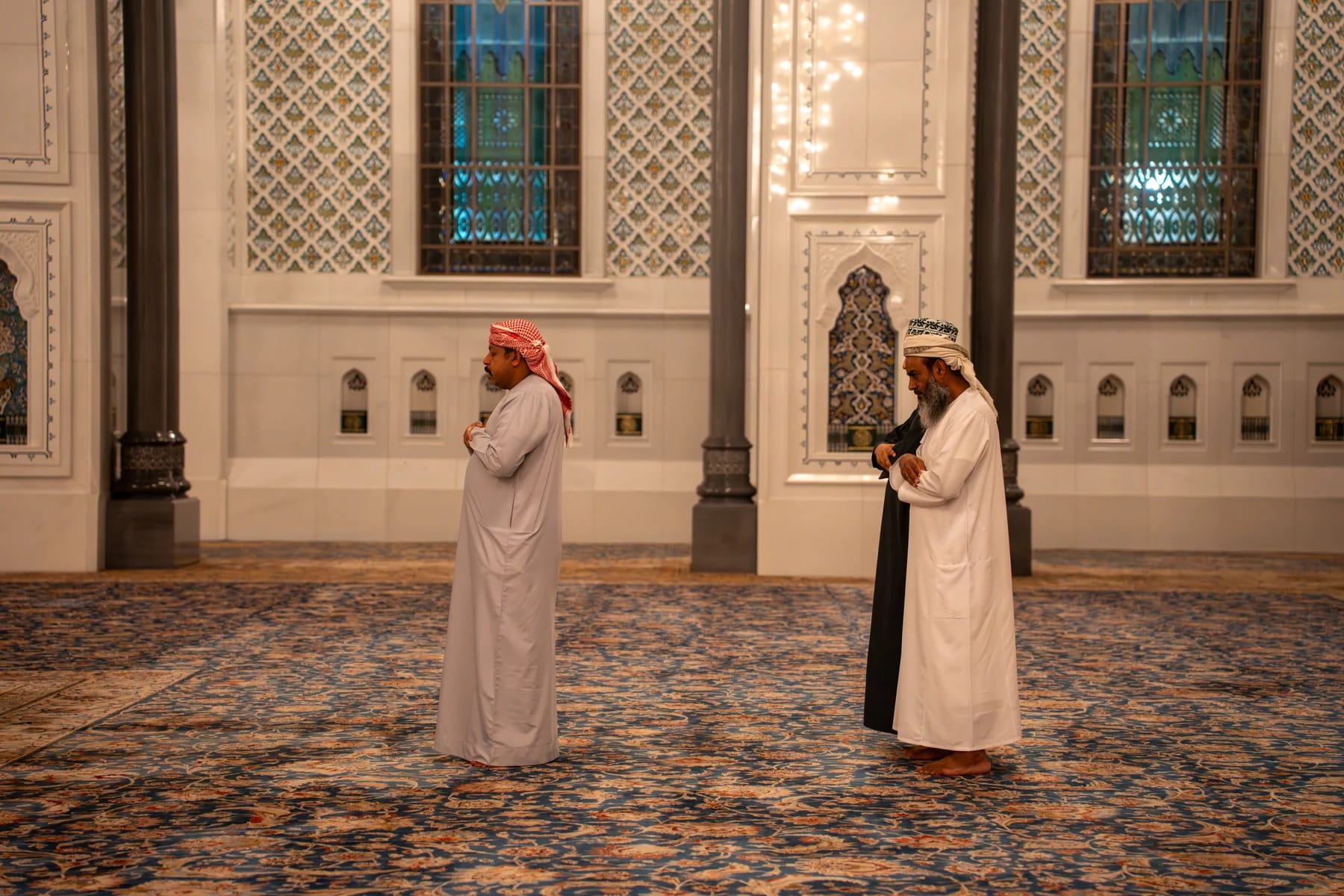
Friday in Oman has its own pace. Streets are calm in the morning, many places open later, and the Sultan Qaboos Grand Mosque is closed to non-Muslims on Fridays (on other days: 08:00–11:00). Instead of forcing a full sightseeing plan, we worked with it.
At 09:00 we picked up the bike, had a slow breakfast/lunch nearby, and prayed in a local mosque close to the pickup area. Nothing felt rushed. That turned out to be the right move: Friday is a slow day in Oman and you might as well accept it.
By late afternoon, the light changed and Muscat opened up. We went to the Grand Mosque grounds when the heat dropped and the crowds thinned. Even from the outside, the place commands attention: clean lines, pale stone, the scale of it. (If you visit on a weekday morning and can enter, the interior is one of the highlights of Oman.)
Practical
- •Entry: free, modest dress required (shoulders and knees covered; abayas available to borrow)
- •Closed to non-Muslims on Fridays
- •Best visiting time: 08:00–09:30 on weekday mornings (before tour groups)
- •Photography allowed in the grounds
- •Parking: large car park on site
Dinner at Rozna sealed the day. We had fish, and the menu was extensive: easily 20+ different dishes ranging from traditional Omani to fresh seafood. Portions were generous, the setting was low-key, and the quality was solid. Strongly recommended.
Then came the unexpected high point: Al Bustan Beach at night. No tour, no queue, no setup. Just a dark shoreline and flashes of electric-blue bioluminescence in the surf when the water moved around your feet. If you go, keep it dark: no flashlight, just your phone camera and patience.
My trip: February 14
Day 2 started with a problem we hadn't anticipated: luggage.
At the rental shop, we quickly realized the MT-03 wasn't designed for the amount of gear we'd brought. The rear seat was smaller than expected, the frame didn't have obvious anchor points for Rok straps, and our duffel bags kept shifting when we tried to secure them. For 30 minutes we stood in the parking lot, re-routing straps, testing configurations, and watching the clock tick past our planned departure time.
By the time we finally got it stable and roadworthy, it was 12:00. Half the morning - gone. We'd planned to leave at 07:00.
The coastal road (Route 17) delivered anyway. Smooth tarmac carved into cliff faces, the Indian Ocean always on your left, barely a car in sight. On a motorbike you feel every curve and every degree of heat climbing as the sun moves higher. We'd already lost the cool morning window.
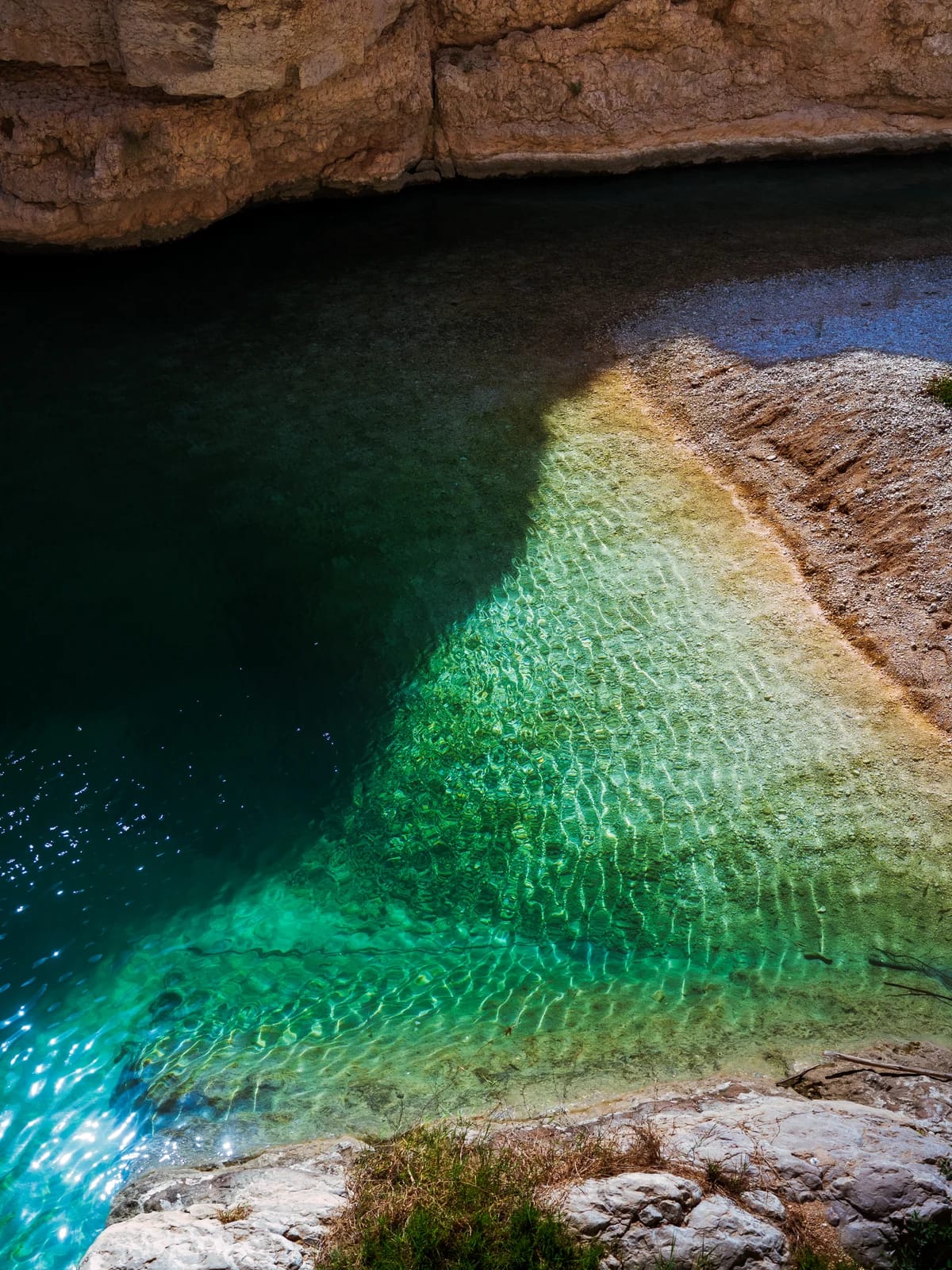
We reached Bimmah Sinkhole around 14:30 - much later than the ideal 08:00–09:00 arrival. The place was still worth it: a perfect circular hole in the landscape filled with turquoise water 40 meters across and 20 meters deep. But the midday heat made it less magical than it could've been, and the tour groups had already come and gone.
Practical
- •Entry: ~1 OMR per person
- •Opening hours: 07:30–20:00 (winter)
- •Best time: before 09:00 (we arrived at 14:30 - too late for ideal conditions)
- •Large parking on-site
- •10 minutes is enough if behind schedule; 45 minutes if you want to swim
- •Bring a dry bag for your phone - the rocks are sharp
We swam for 20 minutes, dried off, and kept moving. The original plan was ambitious: Wadi Shab, Fins Beach, maybe Wadi Tiwi. By 15:30, with the sun at full strength and 100+ km still to Sur, reality set in. Wadi Shab requires at least 2 hours of hiking and swimming. Arriving there at 16:30 would mean finishing in the dark. We skipped it entirely.
The ride south became less about sightseeing and more about heat management. By 16:00, the dehydration started showing: mild headache first, then dry mouth despite drinking what felt like enough water. Dehydration on a bike is silent: you don't feel thirsty until you're already impaired. Reflexes slow, thinking goes foggy, and you realize the mistake 20 kilometers too late.
The lesson that should've been obvious: plain water is not enough in this heat. You need electrolytes, salt, something your body can actually absorb. We didn't have any.
We rolled into Sur around 17:30, later than planned, more tired than we'd admit. We understood how this country works now. The hard version.
Sur itself was a surprise in a good way. Not a tourist town at all - a genuine working fishing harbor with dhow-building workshops still operating, local restaurants without menus, and the kind of quiet that comes from people having real work to do. We found a grill near the water where locals were eating, ordered what they were eating (no English menu, just pointing), and it was exactly what the day needed. Slept hard afterward.
Practical
- •No famous attraction, but genuinely atmospheric
- •Cheap hotels (15–20 OMR for basic rooms)
- •Close to Wadi Shab (~45 min drive) for Day 3
- •Real working town feel - not designed for tourists
Three things we learned the hard way that day: test your luggage setup before you leave, not in the parking lot on departure day. Electrolytes are not optional: we knew it and skipped them anyway. And Wadi Shab needs an early start that we hadn't given it. Day 3, we would.
My trip: February 15
We left Sur at 06:30. The decision to start early on Day 3 changed everything.
Wadi Shab is why people fly to Oman. The guidebooks call it a canyon; it's actually a slice of paradise if you time it right. A narrow gorge of turquoise water, date palms, limestone cliffs - accessible only on foot and by swimming. At 07:00, we had it almost entirely to ourselves. At 09:30, it fills with tour buses.
The entry is simple: park at the main lot near the highway, pay 500 Baisa (~1.3 OMR) for the rowing-boat ferry across the wadi mouth, then walk upstream along the canyon floor. The first 30 minutes is an easy trail. Then the canyon narrows, the water opens into a turquoise pool framed by cliffs, and you're standing in the picture everyone else is taking from a tour bus.
If you're willing to swim, continue another 15 minutes through chest-deep water (holding your dry bag overhead) to reach a cave with an inner waterfall. This part is the highlight.
The real practical bits on Wadi Shab:
- Leave Sur at 06:30 or you've already lost
- Arrive before 08:00 to have it to yourself
- Swimming ability is required for the cave section (you swim through a narrow passage)
- Bring a dry bag for your phone and wallet
- Wear swim shoes: the rocks are sharp
- Return by 10:00 at the latest
- Bring your own water + electrolytes (nothing in the wadi)
We were out of the wadi by 09:45, dried off by 10:30, and already driving toward Nizwa. The route goes through Ibra - a town we skipped but probably shouldn't have. Ibra has an old-town souq selling frankincense, silver, and traditional Omani dress. If you're there on a Wednesday, the Bedouin women's market runs from sunrise to noon and is supposed to be exceptional. Twenty minutes is enough for a quick walk-through. Worth the detour if your schedule allows.
The road to Nizwa is fast motorway. By midday the light became harsh and unpleasant. We pulled over at a petrol station for an hour, sat in the shade, and let the worst heat pass. By car, you barely notice this break. By motorbike, it becomes necessary.
Nizwa itself, when we finally arrived around 15:00, felt immediately right. A mountain town with real markets still operating, rooms that do the job, and enough space to breathe after three days of moving.
After three days of Omani food, we walked into Olio Italian Restaurant without a second thought. Proper Italian pizza: crispy base, good ingredients, better than it had any right to be. We didn't feel bad about it.
Why Nizwa is the best base for the mountains
- •Center point for Misfat, Jebel Shams, Bahla Fort, and the Hajar range
- •Hotels 20–30 OMR for good rooms
- •Two genuinely worthwhile sights (Fort + Souq) without needing to leave town
- •Restaurants that aren't tourist traps (Olio for Italian, local spots for Omani)
My trip: February 16
The Nizwa Fort is probably the best-preserved fort in Oman: a massive circular tower dominating the old town. Entry is 5 OMR but includes access to the exhibitions inside. The view from the top alone is worth the ticket: Nizwa's flat-roofed old quarter, the mountains behind, the mosque minaret next door.
Duration
- •Nizwa Fort: 1–1.5 hours is right
- •Souq: 30–45 minutes (adjacent, worth the walk-through)
- •Combined: plan 2.5 hours including chai break
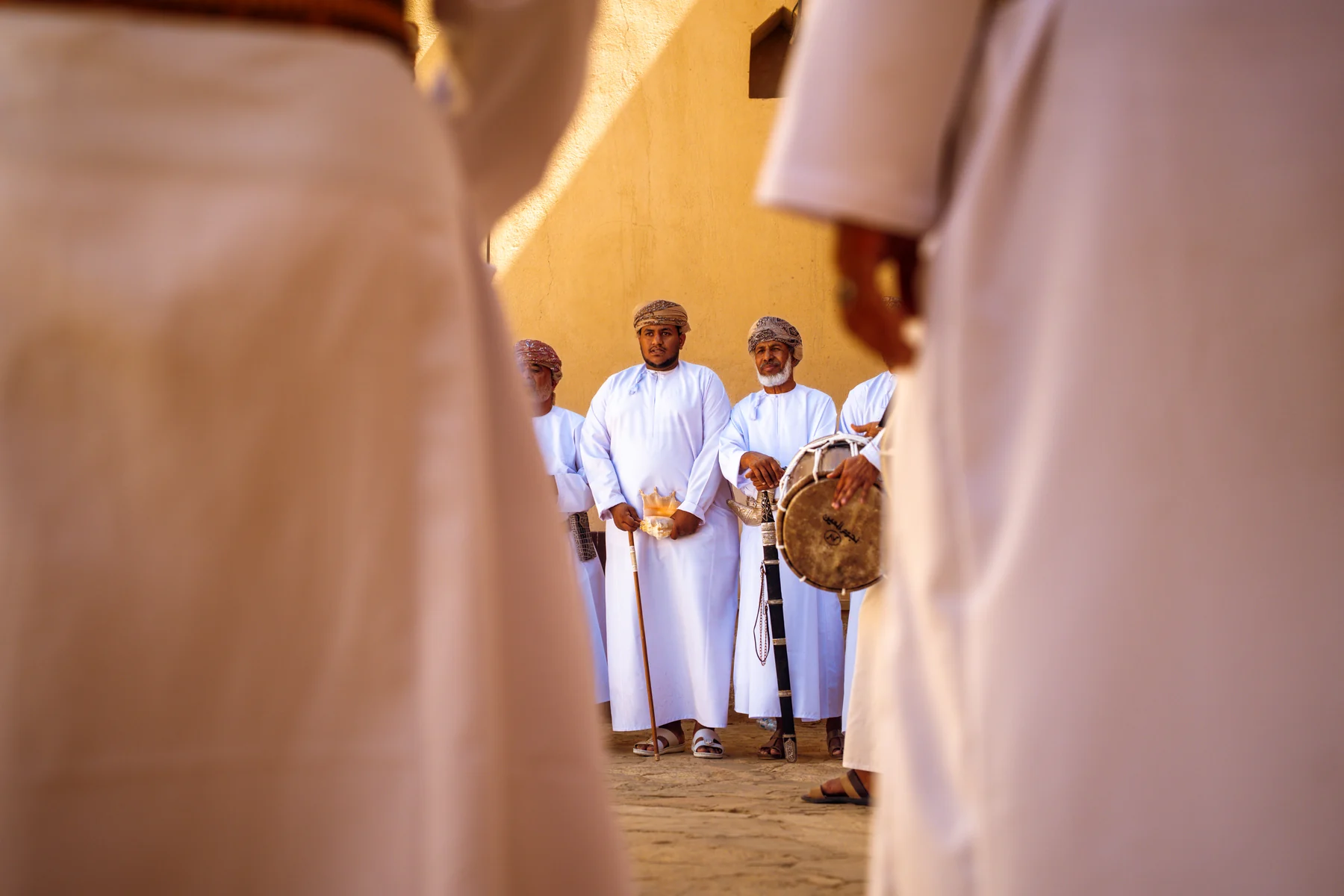
The Nizwa Souq on a Friday morning is one of the most cinematic scenes in Oman: goats being auctioned in the livestock section, silver vendors in the old arched market, frankincense everywhere. The silver market specifically is unusually affordable: genuine Omani khanjar daggers, jewelry, incense burners.
Sabalat Alaqer was a locals' recommendation: a sit-down Omani lunch spot in Nizwa. Traditional food, low-key setting, exactly what you want after the fort and souq.
Misfat is what Nizwa does to you when you think you've already seen the best of it. A 12th-century village clinging to a cliff at 1000m elevation, still inhabited, famous for its falaj irrigation system: ancient stone channels directing mountain spring water through the village. Walk the channels for an hour.
Practical
- •~45 km from Nizwa center
- •Last 2 km is a narrow uphill road: motorbike handles it easily; car is tight but perfectly manageable in any rental, just slow down and give way to oncoming traffic
- •No entry fee; walking is free
- •Late afternoon light is ideal (soft on the stone, shadows in the channels)
- •Come on a weekday if possible: weekends bring more visitors
Why this stop
- •The falaj system has been routing water through this village since the 12th century. Still works.
- •The village is still lived-in, not a heritage museum
- •Resident cats. Everywhere. Unfazed by tourists.
Tamrah is a rooftop restaurant in Nizwa - the kind of place that surprises you in a mountain town. Good views over the old quarter, karak chai (spiced tea) that's better than most places, and the kind of roof where you end up staying two hours when you planned one. After Misfat's late afternoon climb, it was the right place to land.
My trip: February 17
Jebel Shams is Oman's highest peak and home to a canyon called "Oman's Grand Canyon." It's 90 minutes from Nizwa and should be on the list.
We skipped it because of fatigue from 4 days on the road and because we were planning to come back.
If you go: The main road to the viewpoints is tarmac. The last section toward the top has a gravel stretch: not difficult, just slow. By motorbike: straightforward. By car: any standard rental manages it fine, just reduce speed. The Balcony Walk (W6 route, 2 hours) is the reason to go. Plan: leave luggage at the Nizwa hotel or lock it in the car boot, drive up with just a day bag, do the walk, return. Don't try to do Jebel Shams as a detour on the riding day toward Muscat: you'll arrive exhausted.
The highway back to Muscat (Route 15 then 1) is fast and unremarkable. We made two stops:
- Petrol + electrolytes at a highway station, 20-minute shade break (by bike: necessary; by car: comfortable but worth the stop)
- Royal Tulip Muscat late check-in: solid upgrade for the last Muscat night if budget allows. Good pool, decent restaurant, central enough for Muttrah access.
At Kaia, I kept it light with an açai bowl and my friend ordered tuna toast. Simple, fresh, and a good reset after long driving days.
Muttrah Corniche Souq is the oldest covered market in Muscat: a labyrinth of frankincense vendors, spice merchants, antique silver, and pashminas. It's touristy and real simultaneously. Buy frankincense here. It's cheaper and better quality than the airport.
Before entering the souq, we stopped at a nearby mosque for prayer. Outside, we met a group of boys who were studying there. They were curious, warm, and completely at ease in front of the camera, so we took a few portraits together.
Duration
- •45 minutes to an hour is enough; longer if you're buying gifts
- •Best in the evening (cooler, atmospheric lighting)
- •Parking: available along the Corniche
Why this day works
- •Rest day framing: the highway is easy, Muscat handles itself
- •Muttrah in the evening after a strong afternoon brunch/lunch at Kaia works well
- •The Royal Tulip is a small reward after 5 days on the road
My trip: February 18
Qantab is a tiny fishing cove 15 km from central Muscat. No beach clubs, no resort infrastructure. Just a concrete jetty, a handful of local boats, and one of the best day trips available in the country.
We booked via @alfarsi_tourism on Instagram: a local boat operator running 3-hour trips from Qantab for 30 OMR per person.
- Turtles: green sea turtles are common in these waters year-round. We saw three within the first 30 minutes.
- Reef sharks: not dangerous, blacktip reef sharks visible through clear water near the reefs.
- Snorkeling stop: one reef snorkel (equipment provided or bring your own)
- Dolphins possible: not guaranteed, but pods frequently spotted in February
The boat is a traditional fiberglass fishing vessel. No frills, no catering: bring your own water (they don't provide it), wear sunscreen, bring a hat.
After snorkeling, we drove to Kaleem near the shore for a late lunch. I had a warm pistachio cookie-dough dessert, and my friend went for tuna toast again. Casual spot, exactly what we needed after three hours on the water.
Practical
- •30 OMR per person (3 hours, confirmed trip cost)
- •Book via Instagram direct message 1–2 days ahead
- •Bring: water (2L minimum), sunscreen, hat, snorkel mask if you have one
- •Small parking area at Qantab cove: fine for both car and bike
- •Best months for turtles: year-round (nesting peak June–Oct, but resident turtles always present)
Finished the trip at Qurum Beach watching the sunset. Free. No agenda. The best possible final evening.
My trip: February 19
Vehicle drop-off at 10:00 (confirm your rental shop's terms in writing when you pick up). Airport transfer from Muscat, flight home.
The post-trip feeling: Oman doesn't leave a gap the way some countries do. It leaves something quieter: roads that worked, good light, a country that didn't require managing. The highlights were real. Nothing went seriously wrong. That's rarer than it sounds.
The 6-day loop is the default. Adjust based on your time and interests.
The Optimized Loop
6 daysMuscat → coast → Sur → Wadi Shab → Nizwa → Jebel Shams → Muscat
Wahiba Sands, Ras Al Jinz
Coastal drive + wadis + mountains + sea day
Most travelers. Complete experience in 6 days.
Extended Version
8 daysSame loop + 1 extra night in Nizwa + Wahiba Sands night
Nothing essential
Add Wahiba Sands dune overnight + Ras Al Jinz turtle walk
Those with time and a 4WD rental.
Short Break
4 daysMuscat → Wadi Shab → Nizwa + Misfat → Muscat
Jebel Shams, coastal Sur drive
Best single wadi + mountain village
Long weekend. No compromise on quality.
The 6-day loop is the default. Adjust based on your time and interests.
The Optimized Loop
6 daysMuscat → coast → Sur → Wadi Shab → Nizwa → Jebel Shams → Muscat
Wahiba Sands, Ras Al Jinz
Coastal drive + wadis + mountains + sea day
Most travelers. Complete experience in 6 days.
Extended Version
8 daysSame loop + 1 extra night in Nizwa + Wahiba Sands night
Nothing essential
Add Wahiba Sands dune overnight + Ras Al Jinz turtle walk
Those with time and a 4WD rental.
Short Break
4 daysMuscat → Wadi Shab → Nizwa + Misfat → Muscat
Jebel Shams, coastal Sur drive
Best single wadi + mountain village
Long weekend. No compromise on quality.
Oman is the easiest hard trip you can take. Easy in the ways that matter: no visa complications for most Western passports, English everywhere, roads that are properly good, food and accommodation that won't eat the budget. Safe in a way that stops being a talking point after day one and just becomes the background.
Hard in the way the heat and the distances are always real. Oman is bigger than any single trip can cover. Six days is enough to see the shape of it. It's not enough to feel like you're done.
On a motorbike, Oman gives you every curve of every road. In a car, it gives you everything through a window that you then step out of. Both versions are worth it. The route is the same. The roads are the same. The experience diverges as much as the gap between wind in your face and a climate-controlled cabin: exactly that, no more. Both camps tend to oversell their side.
Six days gives you the shape of it. Ten gives you the substance. Fourteen gives you something you'll carry home.
"Oman doesn't surprise you with difficulty. It surprises you with how straightforward it is to have a good trip."
Questions about this route? Found a better restaurant in Nizwa? DM on Instagram or use the contact form below.
Also read: Kyrgyzstan 14-Day Roadtrip Guide →
From my photography collection
Photos from: Muscat, Wadi Shab, Nizwa
Travel stories in your inbox
Get notified when I publish new field notes, photo essays, and behind-the-scenes content from my expeditions.
No spam, ever. Unsubscribe anytime.